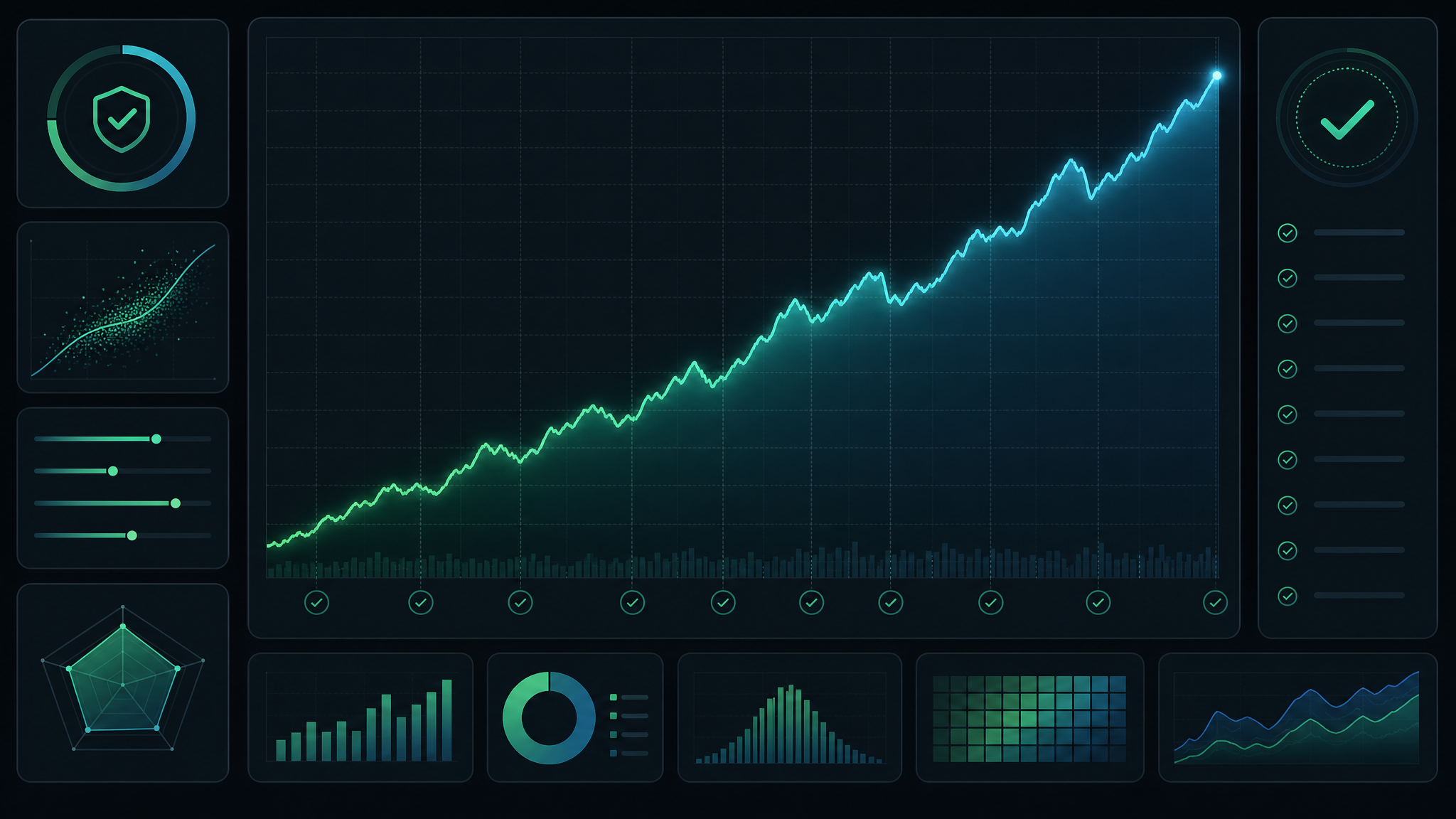
Key takeaways
- A great-looking backtest is easy to fake and easy to believe.
- Overfitting, lookahead bias, and survivorship are the three big lies.
- Deterministic, reproducible tests are the antidote to self-deception.
Backtesting is the single most valuable — and most misused — tool in a trader’s kit. Done well, it tells you how a strategy behaved across different regimes. Done badly, it becomes an elaborate way to confirm what you already wanted to believe.
The three ways backtests lie
- Overfitting — tuning parameters until the curve looks perfect on past data, then watching it fall apart on anything new.
- Lookahead bias — accidentally using information that would not have been available at decision time.
- Survivorship bias — testing only on assets that still exist today, quietly ignoring everything that failed.
What an honest test looks like
Honesty in backtesting comes from constraints. Use realistic assumptions, keep parameters simple, and judge a strategy by how it behaves across many market conditions — not by a single dazzling equity curve. Ask "how did this do in the worst stretch?" before you ask "how much did it make?"
If a strategy only shines with one exact parameter set, you have found a coincidence, not an edge.
Reproducibility is the point
Sentrivest runs backtests against real historical data deterministically — the same strategy and window always produce the same result. That reproducibility is what makes a test trustworthy: you can change one variable, re-run, and know that any difference came from your change, not from noise.
For education, training and simulation only. Not financial, investment or trading advice. Simulated/paper results do not represent real trading and are not indicative of future results.